Ever since I have been living away from my mother, I miss the warmth of her kitchen a lot. The smell of a fresh plate of anything she cooks. Eating directly from the kitchen counter without waiting until it gets served on the table. To me, her cooking is a craft that sits right in her intuition. My mother never needed to measure, and I couldn't stop measuring. But thankfully, for my favourite dish, a traditional Gujarati sweet called sukhadi, she gave me the exact measurements. It has just three ingredients — wheat flour, jaggery and ghee. This meant there was nowhere to hide when something went wrong. The trick, I thought, was in the way you cook the three together because those three are very common ingredients for a lot of other sweets. Little did I know, that was not the only thing. So the first time I started to cook it, I got her on a video call, and as I was assembling the ingredients, wheat flour — done, jaggery — done, ghee…? "Are you sure I need to add THIS much ghee?", I asked her. She said I should trust her and add it in. I couldn't believe that ghee and flour go in almost a 1:1 ratio. That felt like a lot of ghee to me. I joked with her that I wouldn't be able to let it out of my hand. I would have to blindfold myself to do this act of what seemed like absolute catastrophe. That day, I still added it in. I felt like I would be slurping out of a pool of ghee, me and my naïve mind! Back then, I had very little understanding of how ingredients react with each other. But I did have all the world's information on portion control, fat control and had also reached my maintenance body weight a year or so ago. I wasn't trying to control the fats in my food very consciously, but if I were adding a considerable amount of ghee in something I was going to eat within days, I was sure to notice and hesitate. Even so, I continued and added the exact amount of ghee she asked me to add. She insisted that if I reduced it, I wouldn't like it. It would fall and crumble apart. I just couldn't see how! And 5 mins later, there I had it, the perfect marvel I would gaze at in my mother's kitchen. It wasn't a pool of ghee I would slurp from, to my utter disbelief. It was a plate of sukhadi I could cut into beautiful pieces. Before I let it cool and set, I already ate a fourth of it. And there I had it — the sweet I am never able to resist, just this time, it was me who made it.
As time progressed, I made more of it. Once a month, over the weekends, or on weekdays, whenever I felt like it. Whenever it came to assembling the ingredients, something pulled my hand back on the ghee. It felt like my mother was lurking from behind, disappointed in me as I tried to reduce the amount of ghee I would add. One of those attempts gave me cookie crumble instead of sukhadi because there wasn't enough fat to hold it together. It did taste good, but it didn't taste warm. It didn't take me back to my mother. This is not what she taught me. I thought I forgot how to make this. I called her again and asked for the recipe. The weekend after that, I tried to follow it exactly. But I ended up with the cookie crumble again. I was disappointed, but I feel like she would have been more disappointed with my fear. Whenever I pulled my hand back on the ghee, I would have so many words floating in my subconscious — good job on controlling the fats, portion control is the way to go and so on. I would show her my disasters too — the cookie crumbles. She would just point out fairly that I might have not taken ghee by the correct measure. I would nod, and say I'll be more careful next time. But it would sink in. I was reducing the amount of ghee subconsciously.
Was I really trusting my social conditioning more than the woman who brought me up? But in a world of portion controls, it can sadly get difficult to trust the intuition of even 40+ years of cooking. Years of reading up on the perfect portions and endless nutrition noise made me think better answers existed somewhere far from home. How could just a little bit of one ingredient that is demonised everywhere make or break the dish? On the one hand stood my subconscious fear of weight gain, and on the other, my mother's craft.
Eventually, I stopped making it that frequently due to a very busy schedule. Last week, I got back to it. This time, with more information on how ingredients are supposed to interact. With more wisdom on how there are places for portion control and places that make you feel warm and at home, and portion control has no place there. I realised it was time to blindfold myself and add the exact amount of ghee she taught me to add. And so, there I was, with my assembled ingredients, with the stove on and everything. I added the wheat flour in. Now it was time for ghee. I didn't close my eyes. I just trusted her and let the ghee in. The output? Almost perfect pieces that tasted very close to my mother's craft. Almost because some part of it still started to crumble. I was still short by about half a teaspoon (yes, of all the resistance, this was still something I was not able to let go!).
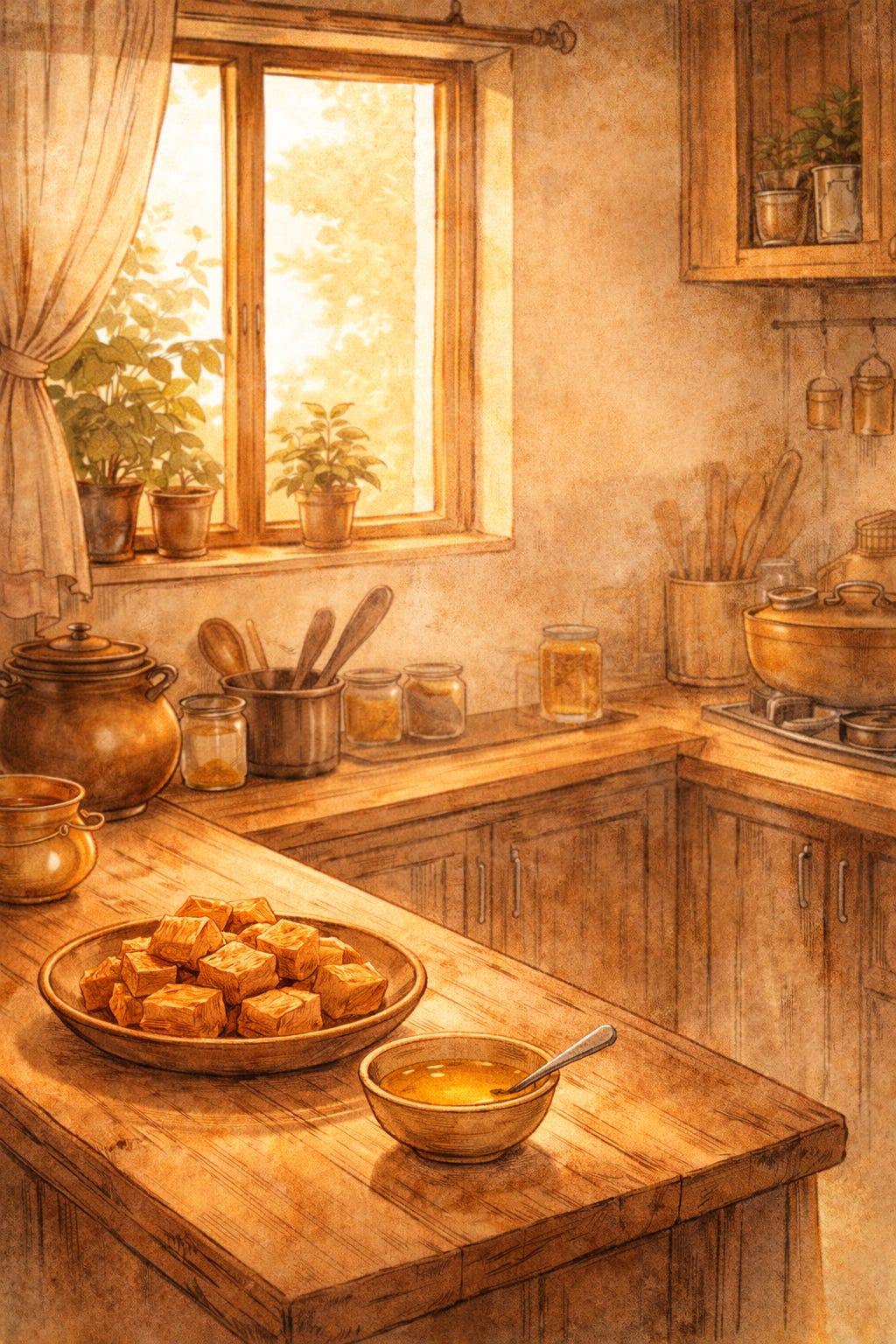
My mother measured with her palm, I measured with my fear.
My next attempt won't fall short of even that one teaspoon, I won't need any blindfolds. Crumbles are not what I want to inherit. I want full pieces that look like they've been woven together through beautiful craft. Craft you can only learn in your mother's kitchen. Craft and intuition you can only inherit from your mother and her mother and her mother. A resistant hand cannot cook what years of intuition and beautiful inheritance can. The knife pressed down and this time, the pieces didn't crumble.
Originally published in The Second Helping. Read it on Substack ↗